Animals are alive. That's really it.
The same reason I'm drawn to the female form, to hands. There's presence, tension, story already built in. You don't have to invent it. You just have to find it in the clay.
Over the years I've made a raku tiger, a raku elephant, naked raku gazelle horns, a vessel adorned with elephants, a set of duck forms, a dove, a hummingbird, a whale whistle, and a frog on a lily pad. Each piece came from somewhere specific. A place, a moment that needed to be made physical.
Raku Tiger
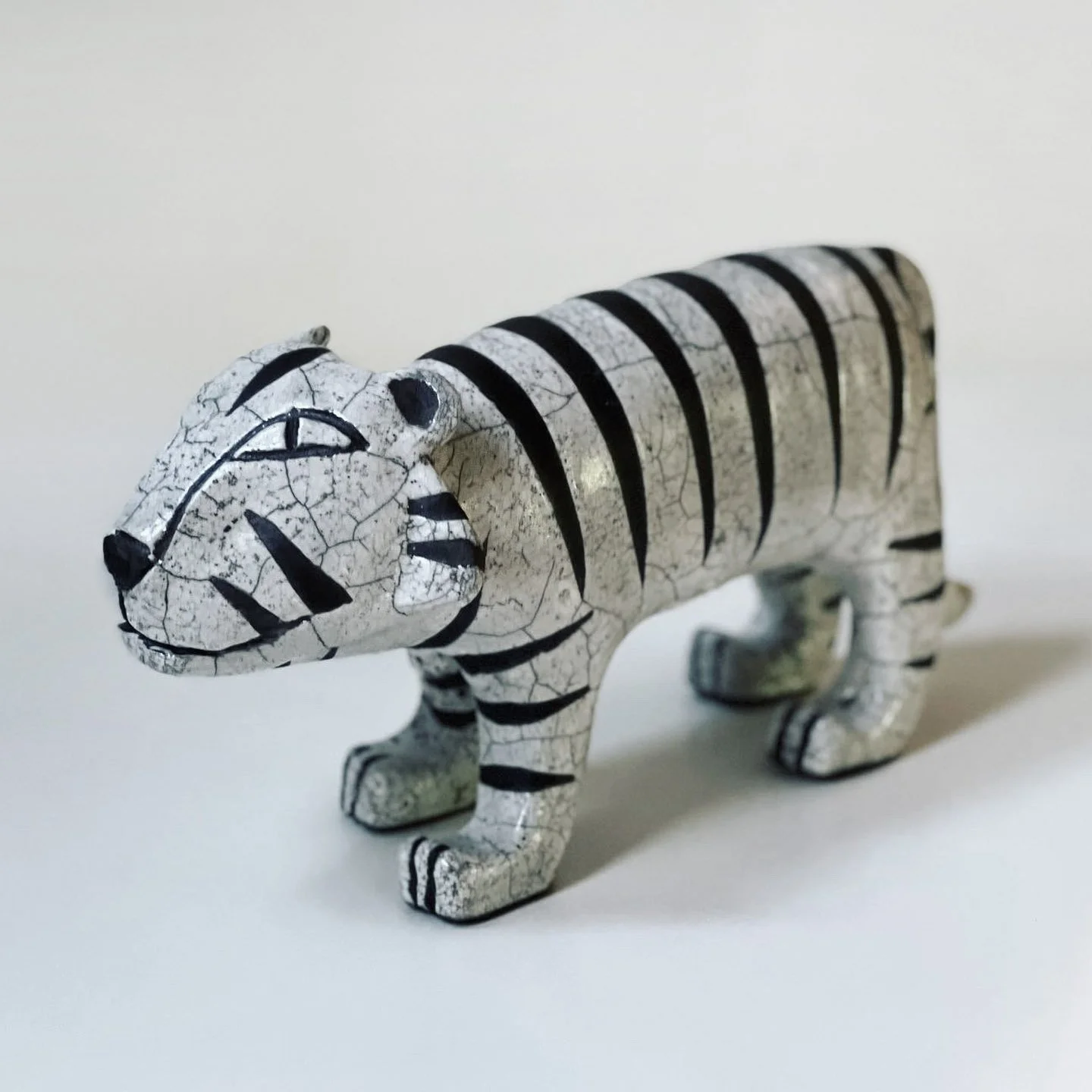
Some pieces get made for the studio. This one was made for my husband.
He's from Memphis, and if you know anything about Memphis, you know the Tigers run deep. Making him a ceramic tiger felt like the right kind of love language.
I chose raku for this piece, and it was the right call. Raku is one of the most unpredictable, exhilarating firing processes in ceramics. You pull the piece red-hot from the kiln, place it into a metal container with combustible materials, and let fire and smoke take over. The results are never fully in your control. The crackled white glaze and bold hand-painted black stripes on this tiger have that quality. They look both ancient and graphic, like something between a Zen ink painting and a folk art figure. I go into the full tape resist process here.
The form is blocky and confident. There's no delicacy here. It sits low and solid, four feet planted, head forward. That felt right for a tiger.
Raku Elephant
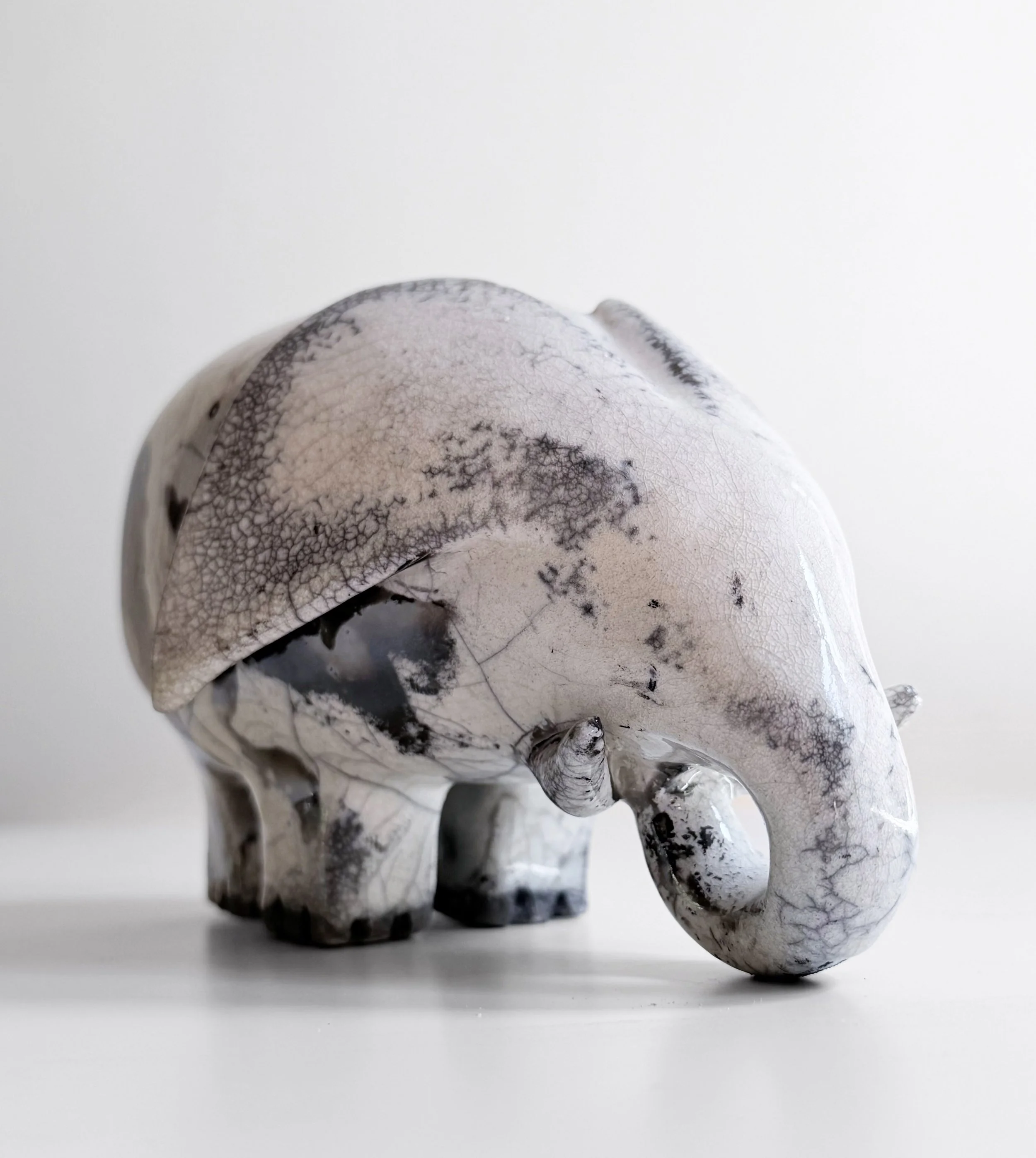
Same firing process, different animal, entirely different energy.
Where the tiger is angular and assertive, the elephant is round and meditative. I built this one with a highly simplified, almost abstract form. The body is a single sweeping curve. The trunk curls back on itself in one clean gesture. The legs are just enough to ground it.
What I love about the raku surface on this piece is the random placement of the crackle. No two pieces are ever the same. Light catches differently across the curves.
Elephants are among the most emotionally complex animals on the planet. They grieve their dead, recognize themselves in mirrors, and form deep social bonds that last decades. They've been known to return to the bones of lost family members years after death.
Across cultures, the elephant carries layered meaning: wisdom, power, good fortune. In Hindu tradition, Ganesha, the elephant-headed deity, is the remover of obstacles and the patron of new beginnings. For me, they represent patience, endurance, the long view.
Gazelle Horns
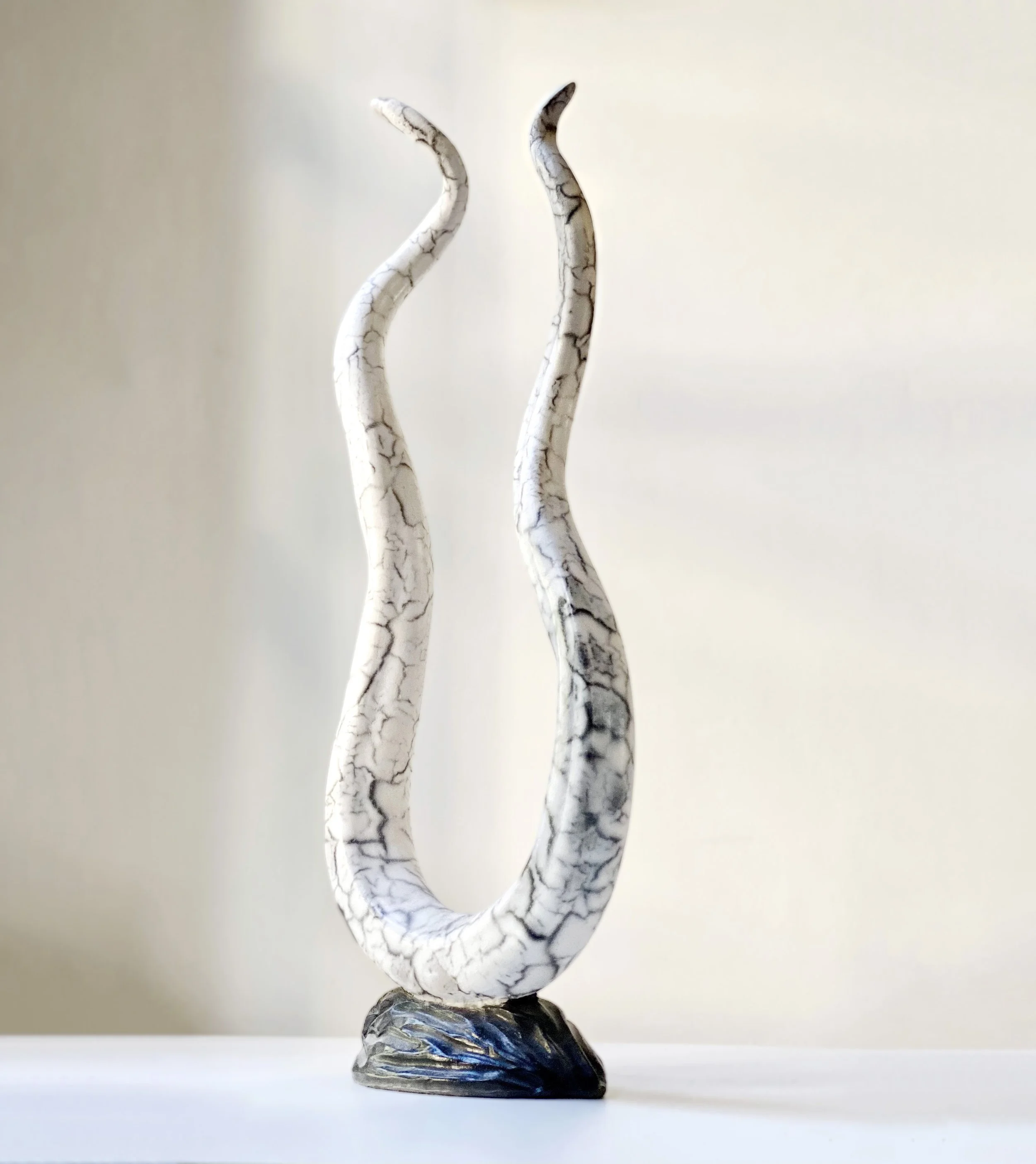
An African safari is on my bucket list. Until then, this is my homage.
These are modeled after the horns of a gazelle, that long spiraling upward reach that feels more like a gesture than a natural form. Two coiling horns rising from a dark sculptural base, each one twisting independently before curving toward the sky.
The technique is naked raku, my absolute favorite alternative firing method. Curious about the difference between raku and naked raku? I wrote about it here. The process involves applying a slip that resists the glaze, which is then peeled away after firing, leaving behind a raw, crackled surface that looks almost like weathered bone or ivory. The dark smoked base grounds the whole piece and creates a dramatic contrast with the white above.
Naked raku is not widely available as an alternative firing method anymore, which makes these pieces feel even more special to me. The horns are purely sculptural. No function, no utility. Just form and surface and the drama of two lines reaching upward.
A Note on Raku
Raku appears in several of these pieces, so it's worth a brief explanation. Read the full breakdown here.
Raku firing originated in 16th-century Japan, rooted in the wabi-sabi aesthetic — the beauty of the imperfect and transient. Western raku, which is what I practice, leans into dramatic surface effects created through post-firing reduction. The piece comes out of the kiln red-hot, goes directly into a container with combustible material, and fire and smoke finish what the kiln started.
No two pieces come out the same. You plan, then you let go.
The Elephant Vessel
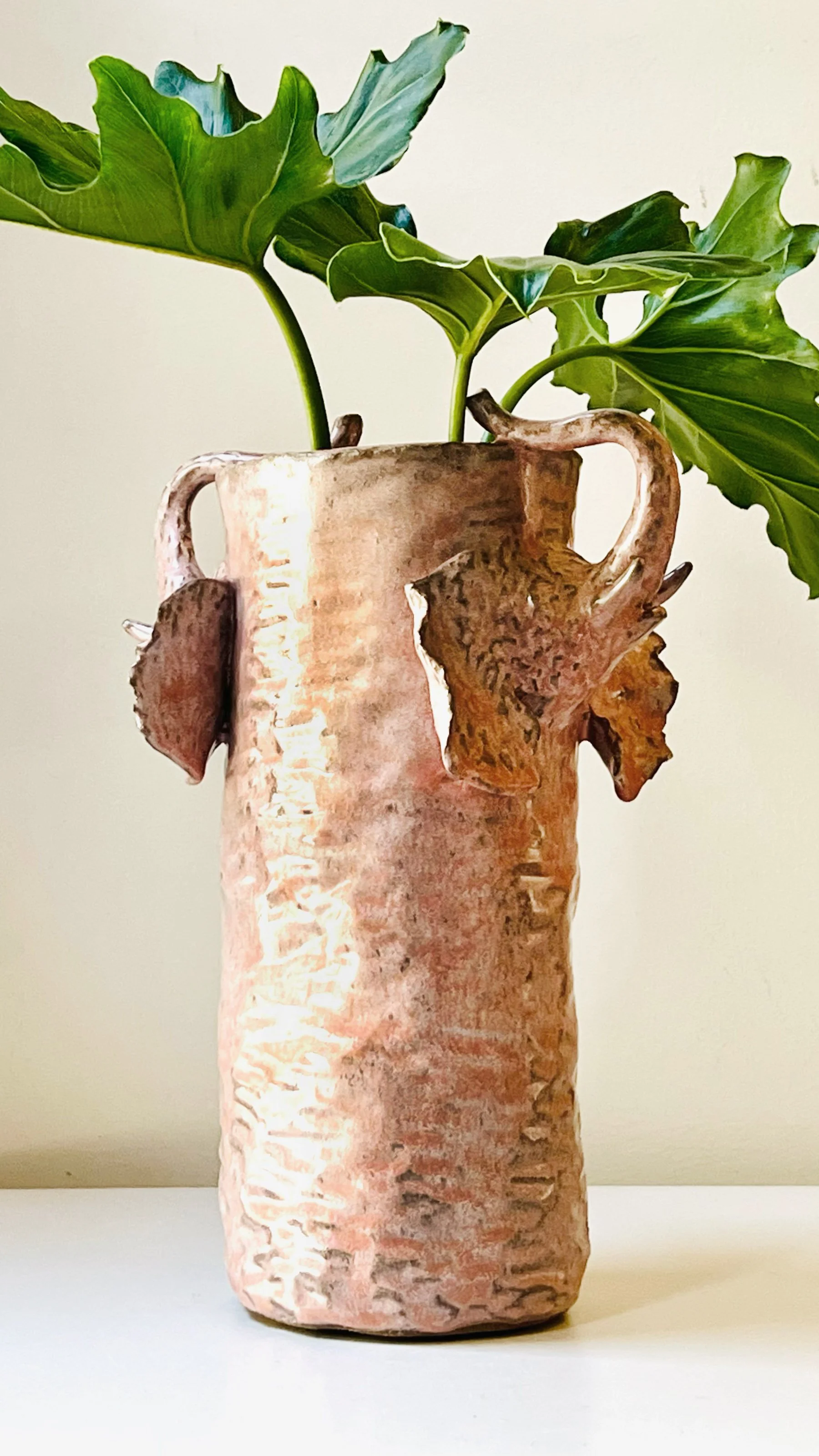
This one started with a hand-built textured base and a clear intention: I wanted to flank the top with two elephant heads, trunks raised.
Trunks up is significant. It's the posture associated with luck and good fortune. The elephants in full salute, energy flowing upward and outward. There's an openness to that gesture.
The surface has the quality of something excavated. Rough, warm. I used a brown clay intentionally, so the semi-opaque glaze would break and reveal the clay body underneath, adding to the earthy, organic quality of the piece. The elephant heads are gestural, not literal, which is true of most of the animals I make.
Two Halves, One Whole: Duck Sculptures
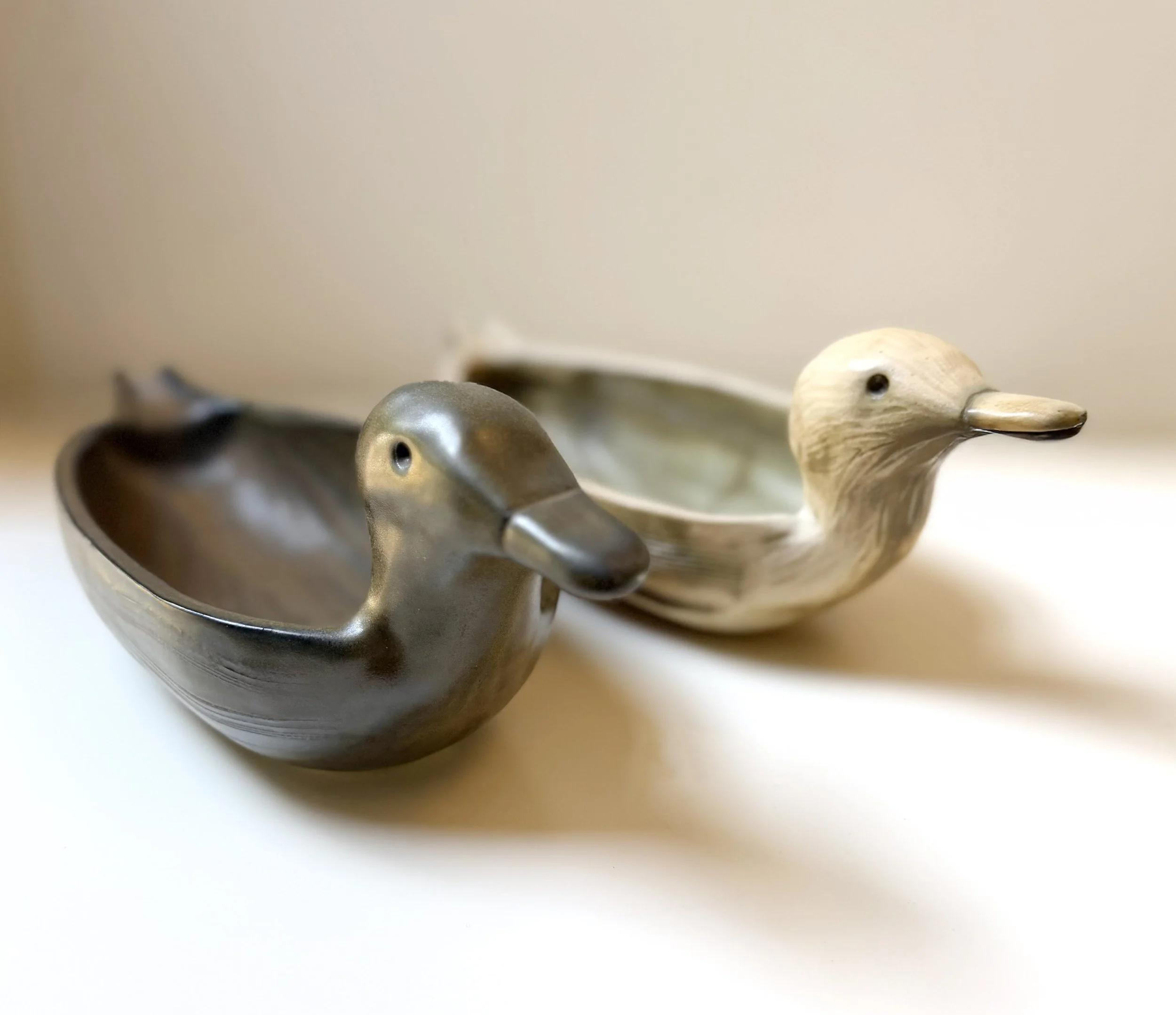
These came out of a rabbit hole that started with a video of a Chinese ceramic artist.
The technique caught my attention immediately. He threw a bottle vase, that tall closed form with a wide body that tapers to a narrow neck, let it firm up slightly, then cut it in half lengthwise before it reached leather hard. Two boat-shaped halves, each one a natural vessel.
I tried it. It worked. Then I hand-built the duck heads and tails and attached them to each half, subverting a traditional form into something new.
In hindsight, hand-building both pieces from the start would have been more straightforward. But that's not really the point. The challenge was the point, and the process taught me something I wouldn't have learned the easier way.
I glazed one in a deep, dark brown. The other got the rainbow stain treatment, wiped away except for what settled into the crevices, then dipped entirely in oatmeal glaze. The result is that warm, aged patina I keep coming back to. The two side by side tell the whole story.
Sanctuary: The Dove
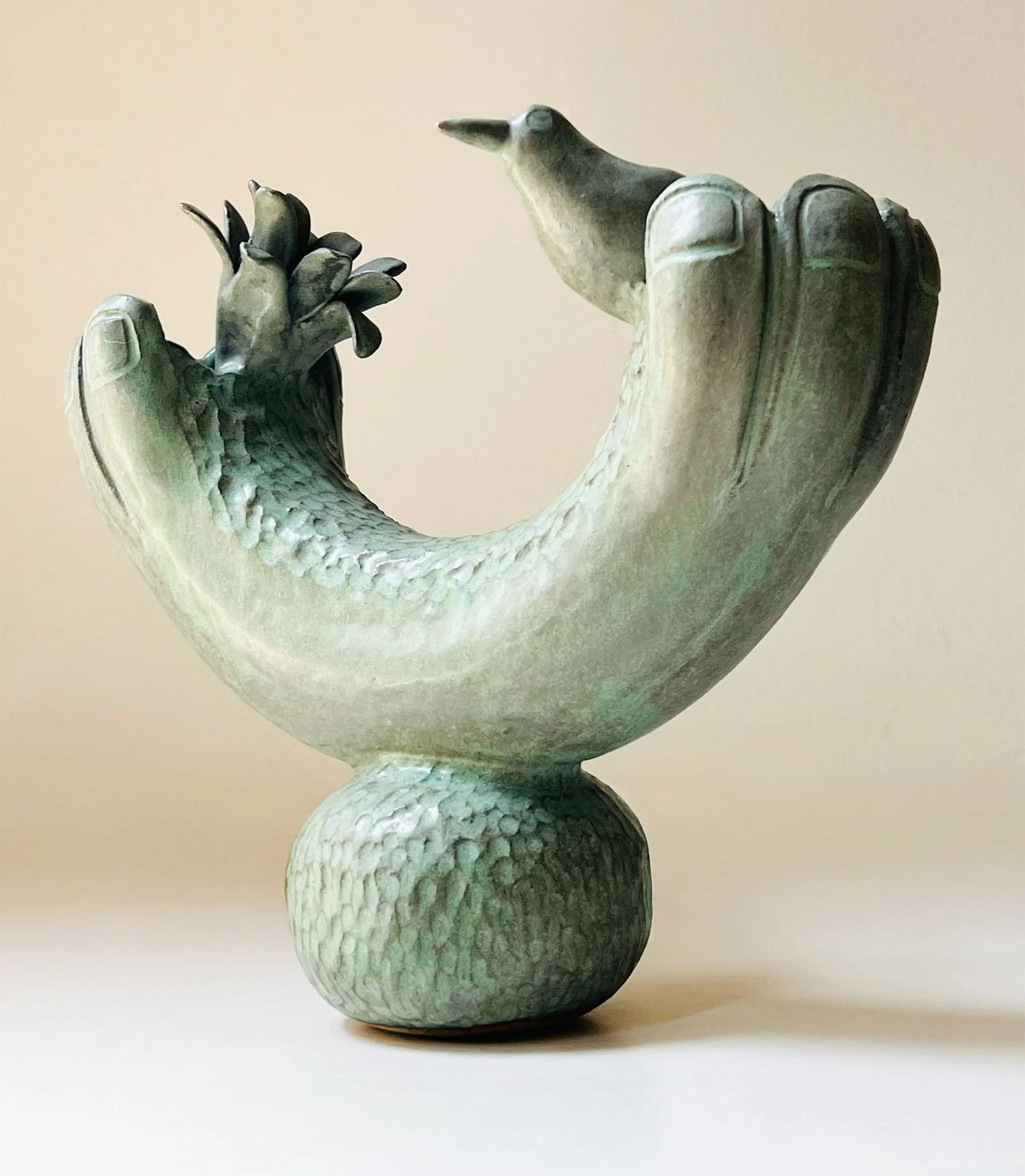
Sanctuary is a piece I've written about before. Here I want to focus on the dove.
The form is a pair of open hands rising from a textured base, built from a wheel-thrown donut form that I reshaped by hand. Nestled in those hands: a dove and a cactus bloom.
The dove is one of the most durable symbols in art and culture. Peace. Hope. It appears in the Old Testament, in Greek mythology, in Aztec ritual. Picasso's dove drawings have been part of my visual vocabulary for years, and there's a quiet nod to him in this piece.
The cactus bloom came in as a counterpart. Living in the Sonoran Desert, survival and beauty are inseparable. The bloom brought the composition into balance and gave Sanctuary a sense of place alongside its sense of peace.
In Exchange: The Hummingbird
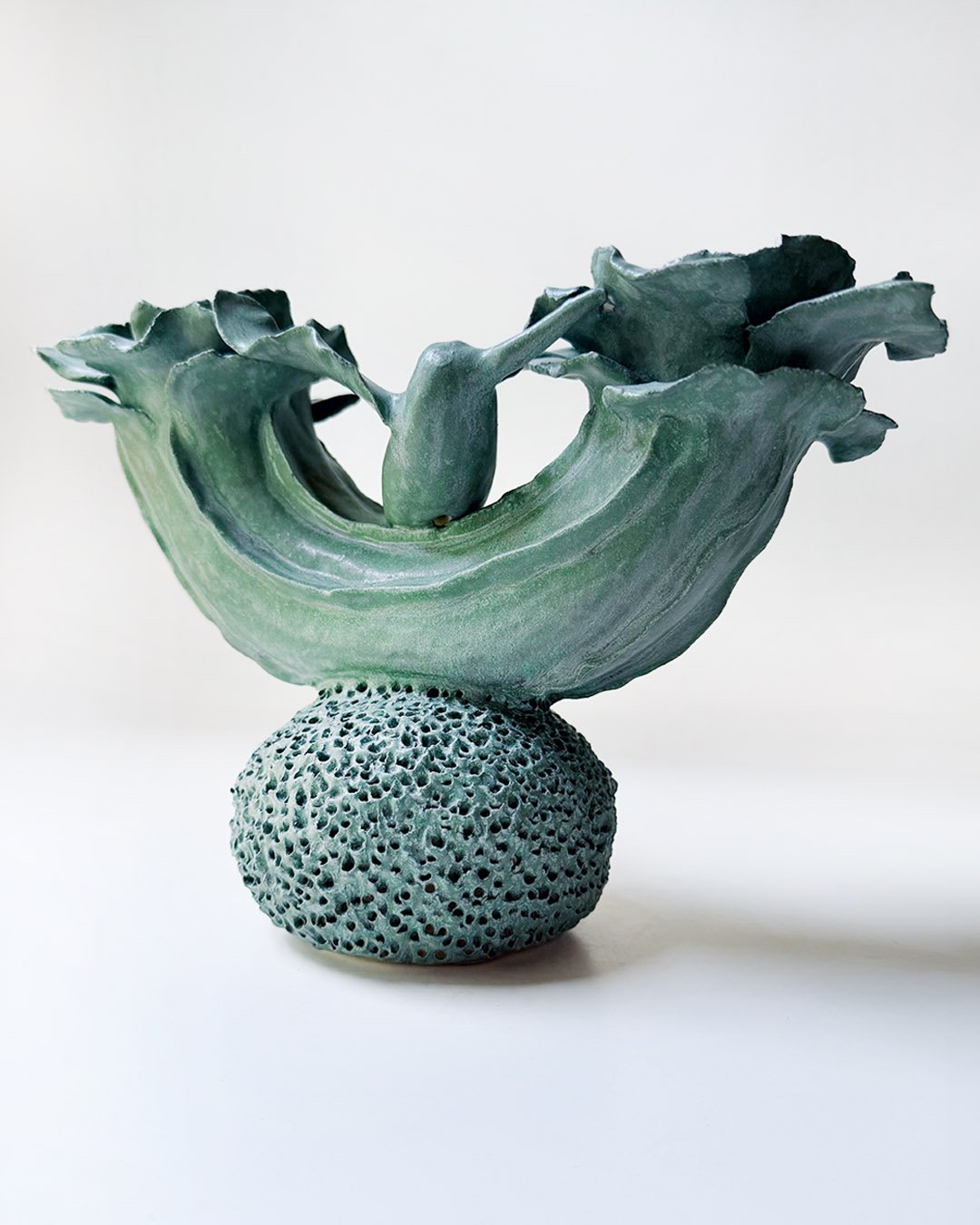
Where Sanctuary is about stillness and holding, In Exchange is about energy in motion.
The form is expansive and fluid. A wide, ruffled vessel that opens like a wave caught mid-crest, balanced on a porous, cratered orb. A small hummingbird emerges from the center of that movement, caught mid-hover in the surge of the form. The whole thing has the quality of something simultaneously flying and blooming.
Living in the Sonoran Desert means living alongside hummingbirds. The Costa's Hummingbird is a year-round resident here. Their wings beat up to 80 times per second, they're the only birds capable of sustained hovering flight, and they can fly backward. During cold nights or food scarcity, they enter torpor, a suspended state where their heart rate drops dramatically, then emerge again, fully burning, at dawn.
Intensity, then stillness. Then intensity again. That rhythm is embedded in the title. In Exchange is about what passes between a creature and its environment. What you give. What comes back.
The Whale Whistle
No photographs of this one. Made years ago, before I was disciplined about documentation.
As a graphic designer, I've always been drawn to the sperm whale as a form. That blunt, squared head. The sheer scale of it.
And of course, Moby Dick. Which I have started and not finished more times than I'll admit. One day, Herman.
The whistle I built was small, hand-pinched, somewhere between a toy and a talisman. Long gone from my hands, but part of the catalog.
Frog on a Lily Pad: A Lidded Jar
No photographs of this one either.
An attempt to recreate a small bronze frog my mother-in-law had in her home in Charleston. Elegant, poised, perfectly still on a lily pad. It didn't turn out quite as refined. Bronze has a precision that clay resists. But, again, the challenge was exactly the point.
In Japanese, the word for frog, kaeru, means "return." Travelers carry frog charms for safe passage home. A detail that stuck with me after our trip to Japan.
For me, a frog on a lily pad is also just a beautiful, serene image. Something perfectly at rest in the middle of water.
These are the animals I've made so far. A raku tiger, a raku elephant, naked raku gazelle horns, a vessel adorned with elephants, a set of duck forms, a dove, a hummingbird, a whale whistle, and a frog on a lily pad. Still on my list: a lizard and a monkey. The subject matter keeps expanding. If any of these pieces resonates, reach out. Studio tours are available in person and on Zoom.